Trump's Tariffs and the End of Globalization
Michael Weidokal, April 2025
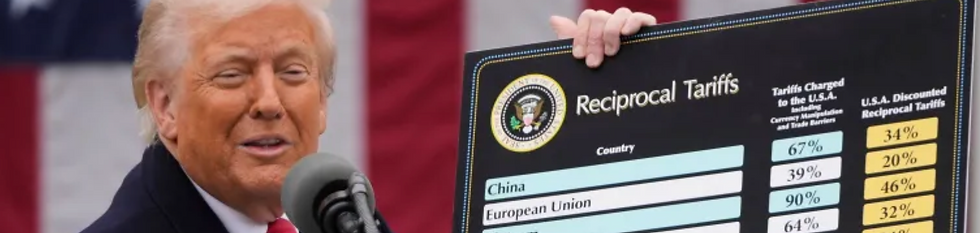
United States President Donald Trump and his “Day of Liberation” promised to dramatically remake international trade and the global economy. However, few economists predicted that the size and scale of the tariffs that the Trump Administration would impose on the US’ trading partners would be so large. As a result, the impact that these tariffs will have on the United States and the rest of the world cannot be overstated. Quite simply, countries, industries, businesses and individuals are facing a dramatically-different world, one in which economic and geopolitical risk levels are substantially higher than in the past.
What is Happening
President Trump took to the White House grounds to introduce sweeping new tariffs on nearly all of the United States’ trading partners. Of course, the calculation used by President Trump to justify these tariffs was highly misleading, as instead of showing the tariffs imposed on imports from the US into other countries, it showed a calculation based on the US’ trade deficit with each country (US trade deficit/US exports). Nevertheless, the tariffs were significantly larger than what was expected, sending shockwaves around the world.
Markets around the world swiftly reacted to these tariffs, with share prices plummeting around the world, particularly for those businesses and industries that are dependent upon trade. Furthermore, economic growth forecasts for most major economies in 2025 and 2026 were downgraded again, as opportunities for most economies to generate growth continued to recede amid rising global trade tensions.
The United States’ leading trade partners reacted in a variety of manners to these sweeping new tariffs. Some, such as China, Brazil and the European Union immediately announced plans for retaliatory tariffs to be placed on imports from the United States. Others, such as India, Japan and Australia, indicated that they had no plans to impose retaliatory tariffs on US imports, at least for now. In short, the 2nd of April will go down in history as the day in which more tariffs were imposed on global trade than any other day in history.
Implications
For the United States, the implications of these sweeping new tariffs are clear. Economically, these tariffs will drive higher rates of inflation, something that could delay future interest rate cuts by the Federal Reserve. Furthermore, the odds for a recession in the United States in 2025 have risen to 50%, a far cry from the near 3% GDP growth achieved in the US in recent years. On the positive side, it is expected that foreign investment in the US, which has been very strong in recent years, will continue to grow as businesses are forced to produce goods destined for the US market in the US. Finally, the political implications are also significant, as higher inflation and slower growth will cost President Trump some of his support, while internationally, the US has alienated many of this closest allies.
The implication of these tariffs for the rest of the world are also very significant, as exports to the United States were one of the key drivers of growth for many countries and industries in recent years. In fact, over the past decade, the US has accounted for 30% of the world’s additional economic output, far more than any other economy. As such, economic growth forecasts for 2025 and 2026 have been significantly downgraded for most major economies, particularly those that are dependent upon trade to generate growth. Two countries that may welcome these tariffs are China and Russia. China, while being hit hard by these tariffs, is in a position to gain global influence at the expense of an increasingly-isolationist United States. Meanwhile, Russia did not have tariffs placed on it by the US, further raising questions regarding the Trump Administration’s relationship with Moscow.
The main concern surrounding these tariffs is the fear that they could trigger a global trade war. While disruptions to global trade are certain, the larger concern is that the actions by the Trump Administration could prompt governments in other countries to impose protectionist measures to protect their local industries. Should this occur, what is expected to be a global economic slowdown could become a global economic crisis. In turn, this could raise geopolitical tensions dramatically, further destabilizing an already-uncertain world.
Summary
The Trump Administration has taken its recent actions on trade with the firm belief that the United States can win any trade war that it finds itself engaged in. This belief is fueled by the fact that the US derives less of its economic growth from international trade than any other large economy, making it far less vulnerable to disruptions in trade than its global trading partners. Nevertheless, there is little doubt that the United States will suffer significant economic and political consequences, particularly if this trade war intensifies. Furthermore, global economic and geopolitical risk levels have been on the rise, and this latest move will only raise these risk levels even further. If this persists, the era of globalization that has driven and dominated the global economy since the 1980s could well and truly be over, ushering in a much more divided and uncertain future.